
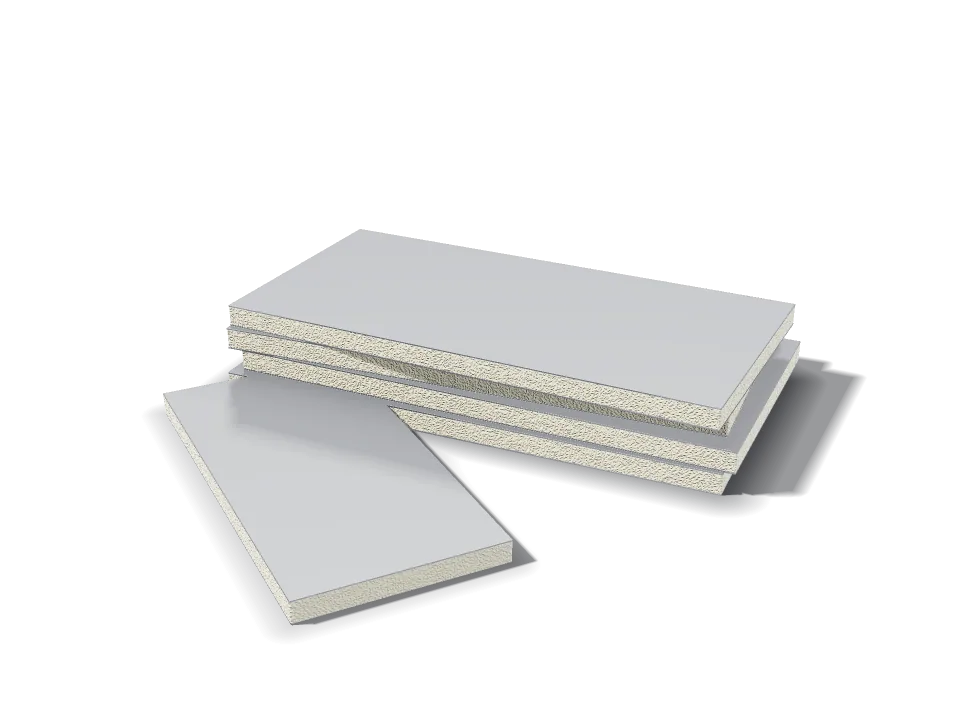
 HS 39211390Illustrative render
PIR Board
Polyisocyanurate, foil / tissue faced
Rigid insulation board with better fire performance than standard PUF, suitable for roofs, walls, ducting, and cold rooms.
Also known as: polyisocyanurate board, PIR insulation panel, foil-faced PIR, PIR pipe section
- Improved fire rating over standard PUF
- Multiple facing options (foil, glass tissue, kraft paper)
- Wide temperature range from cryogenic to high heat
Technical data
| Board Size | 1200 mm x 600 mm / 2400 mm x 1200 mm |
|---|---|
| Thickness Options | 25 / 40 / 50 / 75 / 100 mm |
| Density | 32 - 40 kg/m³ |
| Temperature Range | -180°C to +140°C |
| Thermal Conductivity | 0.021 - 0.025 W/mK |
| Compressive Strength | 120 - 200 kPa |
| Fire Rating | Better fire rating than PUF, Euroclass C-E |
| Facing Options | Aluminum foil / Glass tissue / Kraft paper |
| Standards | EN 13165, ASTM C1289 |
| Packing | Palletized, shrink-wrapped |
Applications
Standards
Manufacturer test certificates and data sheets can be supplied with the order on request.
Customs
Export packing
Palletized, shrink-wrapped. Loads are palletized or cartoned for ocean freight and can be consolidated with other products in one container.
Questions buyers ask
What is PIR board and where is it used?
PIR board is a rigid polyisocyanurate foam insulation board, faced with aluminum foil, glass tissue or kraft paper, used for roof and wall insulation, ducting and cold rooms. It is a closed-cell foam with low thermal conductivity, so relatively thin boards give a useful insulation value. Compared with standard polyurethane foam, the isocyanurate chemistry gives it improved fire performance, which is why it is often chosen for building envelopes and ducts.
What temperature range can PIR insulation board handle?
PIR board is rated from -180°C to +140°C, so it covers cold rooms, chilled ducts and low-temperature process equipment as well as moderately warm surfaces. The upper limit is set by the foam itself, which starts to degrade if held above its rated temperature. For hotter surfaces a mineral fiber product such as Rockwool LRB Slab or Calcium Silicate Block & Pipe Section is the usual choice.
What sizes, thicknesses and densities does PIR board come in?
PIR board is supplied in 1200 mm x 600 mm and 2400 mm x 1200 mm sheets, in thicknesses of 25, 40, 50, 75 and 100 mm, with a density of 32 to 40 kg/m³. Thickness is normally chosen from the required thermal resistance or, on cold duty, from the thickness needed to keep the outer surface above dew point. The larger sheet size reduces the number of joints on roofs and walls.
What is the difference between PIR Board and PUF Pipe Section & Board?
PIR Board and PUF Pipe Section & Board are both rigid closed-cell polyurethane-family foams, but PIR has a modified chemistry that gives better fire performance than standard PUF. PIR Board is rated Euroclass C to E with conductivity of 0.021 to 0.025 W/mK. Choose PIR where fire behavior matters, such as building roofs, walls and ducts; PUF is commonly used where preformed pipe sections are needed.
What is the thermal conductivity and compressive strength of PIR board?
PIR board has a thermal conductivity of 0.021 to 0.025 W/mK and a compressive strength of 120 to 200 kPa. The low conductivity comes from its fine closed-cell structure, and the compressive strength is enough for it to be used under roof membranes and on panels that see foot traffic during installation. To check the thickness needed for a given surface temperature, use the heat-loss calculator on this site.
How is PIR board installed on cold rooms and chilled ducts?
On cold rooms and chilled ducts, PIR board should be fitted with tight, staggered joints and a continuous vapor barrier on the warm side, because moisture entering joints will condense and reduce performance. Joints on foil-faced board are usually sealed with Aluminum Foil Tape, and boards can be bonded with Contact Adhesive. Outdoors or where exposed to damage, the insulation needs protective cladding such as Aluminum Cladding Sheet & Coil.
Which standards does PIR board comply with?
PIR board is made to EN 13165, the European standard for factory-made rigid polyurethane foam insulation products, and ASTM C1289, the US specification for faced rigid polyisocyanurate thermal insulation board. Its fire classification is Euroclass C to E depending on the grade and facing. If your project needs a specific standard or classification confirmed for your order, tell us in your enquiry and we will confirm what is available.
What HS code applies to PIR insulation board for import?
PIR insulation board is exported from India under HS code 39211390, which covers plates and sheets of cellular polyurethane, including the PIR variant. The first six digits, 392113, are the internationally harmonized part, while the final digits and duty rates are set by the importing country. Please check the classification with your customs broker before shipment.
How is PIR board packed for export and what should an enquiry include?
PIR board is exported palletized and shrink-wrapped, which keeps the boards square and protects the facings during sea freight. Because the foam is light and bulky, a load usually fills container volume before weight, so it is often combined with other products in one container. In your enquiry, state the board size, thickness, facing, quantity in square meters or boards, destination port and preferred Incoterm (EXW, FCA, FOB, CFR or CIF).
Export markets
We ship PIR Board to buyers worldwide. Country pages cover ports, standards and documents:
Complete the system.
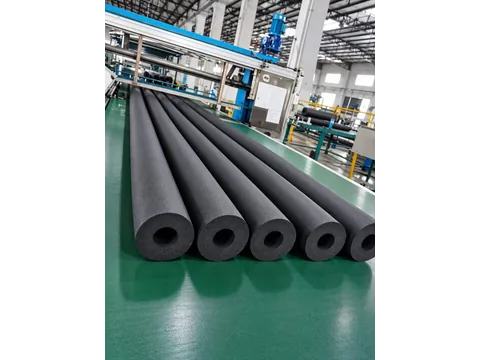
Nitrile Rubber Tube
Closed-cell elastomeric
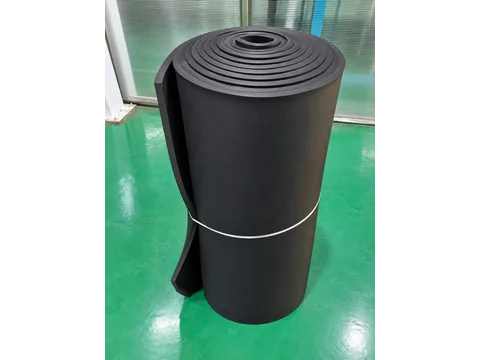
Nitrile Rubber Sheet & Roll
Plain or self-adhesive
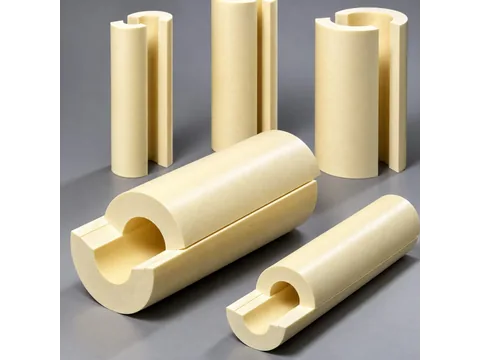
PUF Pipe Section & Board
Polyurethane foam, to −180°C
Contact Adhesive
For nitrile rubber insulation
Need PIR Board shipped?
Tell us the size, thickness, grade and quantity with your destination port. We reply with a priced export offer, packing details and documents.