
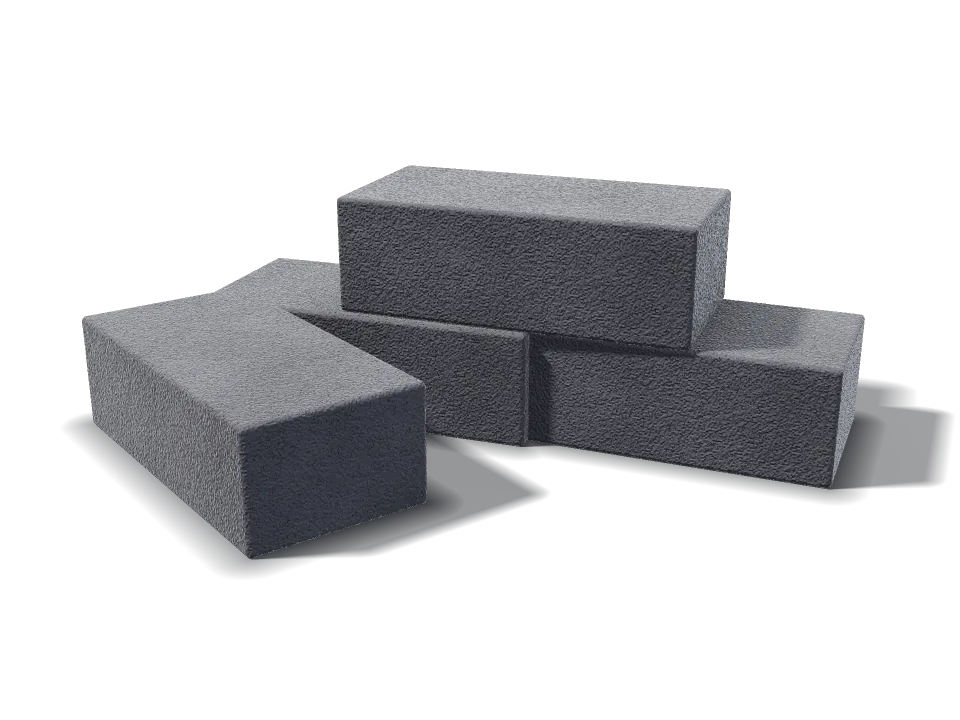
 HS 69022040Illustrative render
Silicon Carbide (SiC) Bricks
SiC 70–90%
High thermal conductivity, high abrasion-resistant refractory brick used in blast furnaces, kilns, and incinerators.
Also known as: SiC brick, silicon carbide refractory, SiC refractory shape
- Excellent thermal shock and abrasion resistance
- High thermal conductivity — good for heat transfer applications
- Resistant to chemical attack
Technical data
| Standard Size | 230 x 114 x 75 mm; custom shapes for kiln furniture |
|---|---|
| SiC Content | 70% - 90% |
| Max Service Temperature | 1600°C - 1800°C |
| Bulk Density | 2.5 - 2.7 g/cm³ |
| Cold Crushing Strength | 600 - 900 kg/cm² |
| Thermal Conductivity | 8 - 15 W/mK (much higher than clay/alumina bricks) |
| Standards | — |
| Packing | Wooden pallets, shrink-wrapped |
Applications
Standards
Manufacturer test certificates and data sheets can be supplied with the order on request.
Customs
Export packing
Wooden pallets, shrink-wrapped. Loads are palletized or cartoned for ocean freight and can be consolidated with other products in one container.
Questions buyers ask
What are silicon carbide bricks used for?
Silicon carbide (SiC) bricks are refractory bricks with 70 to 90% SiC, used in blast furnace linings, kiln furniture, waste incinerators and cyclones. They combine high abrasion resistance with high thermal conductivity and good thermal shock resistance. This makes them suitable where a lining must resist wear from moving solids or transfer heat efficiently.
What is the maximum temperature of SiC bricks?
Silicon carbide bricks have a maximum service temperature of 1600°C to 1800°C, depending on SiC content and grade. In service, the practical limit also depends on the furnace atmosphere, because silicon carbide can oxidize slowly in strongly oxidizing conditions at high temperature. Share the operating atmosphere and temperature in your enquiry so the grade can be matched.
Why do silicon carbide bricks have high thermal conductivity?
Silicon carbide bricks have a thermal conductivity of 8 to 15 W/mK, much higher than clay or alumina bricks, because silicon carbide itself conducts heat well. This is useful in muffles, heat-transfer walls and kiln furniture, where heat must pass through the refractory. It also reduces thermal gradients inside the brick, which helps its thermal shock resistance.
When should I use Silicon Carbide (SiC) Bricks instead of High Alumina Bricks?
Use Silicon Carbide (SiC) Bricks where abrasion, thermal shock or heat transfer is the main concern, and High Alumina Bricks where an insulating, general-purpose high-temperature lining is needed. SiC bricks have cold crushing strength of 600 to 900 kg/cm² against 400 to 700 kg/cm² for high alumina, and far higher thermal conductivity, which is a drawback where heat must be retained.
How strong and dense are silicon carbide bricks?
Silicon carbide bricks have a cold crushing strength of 600 to 900 kg/cm² and a bulk density of 2.5 to 2.7 g/cm³. The high strength and hardness of silicon carbide are what give these bricks their resistance to abrasion from dust-laden gases, clinker and moving charge, which is why they are used in cyclones and incinerators.
What should be considered when installing SiC bricks?
SiC bricks should be laid with a compatible Refractory Mortar and a design that allows for thermal expansion. Because they conduct heat so well, an insulating backup such as Insulating Fire Bricks (IFB) or Ceramic Fiber Blanket & Board is normally needed behind them to control shell temperature. As with other refractory linings, the first heat-up should be controlled.
Are silicon carbide bricks supplied to a specific standard?
Silicon carbide bricks are specified by their properties rather than a single catalogue standard: SiC content, density, strength and service temperature, as listed in the technical data table. If your project calls for a particular standard or test data, state it in your enquiry and we will confirm what can be provided for your order.
What is the HS code for SiC refractory bricks?
Silicon carbide refractory bricks are shipped from India under HS code 69022040, refractory bricks and shapes of silicon carbide. This is part of heading 6902 for refractory bricks, blocks and tiles. The destination country applies its own national subheading and duty rate, so have your customs broker confirm the code before the goods arrive.
Can silicon carbide bricks and kiln furniture shapes be shipped together?
Yes, standard 230 x 114 x 75 mm SiC bricks and custom shapes for kiln furniture can be shipped together on wooden pallets, shrink-wrapped, in one container. They can also be combined with other refractories and Refractory Mortar in a mixed load. For custom shapes, include drawings and quantities with your enquiry; lead time depends on the shapes and is confirmed with the quotation.
Export markets
We ship Silicon Carbide (SiC) Bricks to buyers worldwide. Country pages cover ports, standards and documents:
Complete the system.
Need Silicon Carbide (SiC) Bricks shipped?
Tell us the size, thickness, grade and quantity with your destination port. We reply with a priced export offer, packing details and documents.